
The Science
Our current age is characterised by a never-before-seen level of connectivity that is starkly juxtaposed by an increasing sense of disconnection—from ourselves, from others, and from our environment.
Voice messaging has become increasingly popular in recent years, and we are not surprised. So many of our social interactions have become text-based and less personal, that there is a very understandable yearning to go back to the roots of how humans have survived and developed for millennia—through spoken communication.
Amidst Zoom fatigue and information overload on social media, we started looking for ways to create digital experiences that could better support our psychological needs and foster connectedness. We present the Wisperverse as a new generation of social audio.
“Stories give meaning and value to the places we call home… They hold us together and at the same time keep us apart.”
J. Edward Chamberlin
Emiritus Professor | University of Toronto
43%
of 18-29 year olds use voice messaging weekly
According to a YouGov poll run for Vox.com
The Power of Voice
A vast scientific body of work teaches us about the wellbeing benefits of hearing, listening to, and communicating through human speech.
1
Understanding
We all know how easy it is to misinterpret texts (especially in the absence of emoji!) and potentially as a result of that ‘noise’ end up in a disagreement. When we listen to a human voice, on the other hand, we are able to pick up on so-called ‘paralinguistic’ cues that tell us something about the other person’s emotion, state of mind, and intentions.
For example, a study done at UC Berkeley has shown that hearing someone speak helps remind us that we’re interacting with a living, feeling person, and helps us be a little more understanding and empathetic towards one another. Similarly, a study conducted at Yale School of Management has found that voice-only allowed for the receivers to best recognise the emotionality of the speaker compared to other forms of communication.
2
Allowing for Complexity
Expressing complex thoughts or feelings over text is hard. After all, we are forced to write down—and thereby potentially even immortalise—thoughts that we may not necessarily have all figured out ourselves. Feeling restricted for fear of permanence, or feeling pressured to formulate the exact right sentence can hold us back from exploring and sharing our feelings, and in the long run, even hinder young people’s identity development and psychological wellbeing.
Oral communication, on the other hand, allows for elaboration, corrections and much more flexibility than text. In contexts like our Wisps—where communication is not about efficiency—your voice ends up being able to to justice to the fact that life simply can be complicated.
3
Connectedness & Love Hormones
In light of earlier findings about increased empathic accuracy and humanisation, researchers set out to determine whether we also feel more connected to others when we communicate through voice instead of text. Indeed, findings show that interactions that include voice foster stronger social bonds compared to solely text-based interactions.
What’s more, these bonding effects of the voice are also reflected in our brains, with studies reporting levels of oxytocin release—also referred to as the ‘love hormone’—in response to human voice that is comparable to human touch.
4
Actively Listening
When someone is talking to us, we all know we should be listening. However, with the hectic lives many of us lead, we know that it can be challenging to turn off the 101 things buzzing through our head and really tune in to the person speaking.
But research on so-called ‘active listening’—also simply referred to as ‘high-quality listening’—suggests that when we truly pay attention and listen to understand rather than listen to reply, this may lead to fulfilment of psychological needs and wellbeing for the person being listened to. That is why prompts that help Wisperverse users to engage in active listening are built-in in all of our Wisps.
Storytelling Makes Us Human
Humanity has been sharing stories since its very dawn. Long before we were able to write, we used our voices to share and pass down knowledge, art, and ideas.
All of the audio experiences in the Wisperverse revolve around personal storytelling. Scientific work built up over the past decades has found that sharing stories with one another and making meaning out of our lives through storytelling helps us reflect and develop a coherent personal identity (Pennebaker & Seagal; McAdams & McLean), which are crucial for improving wellbeing.

Our Science-Design Process
As we have seen already, psychological research gives us plenty of why’s behind the Wisperverse’s social audio experiences. However, we believe that transforming a scientific evidence-base into tech-for-good solutions requires an approach that is both structured and flexible, allowing for creative emergent insights.
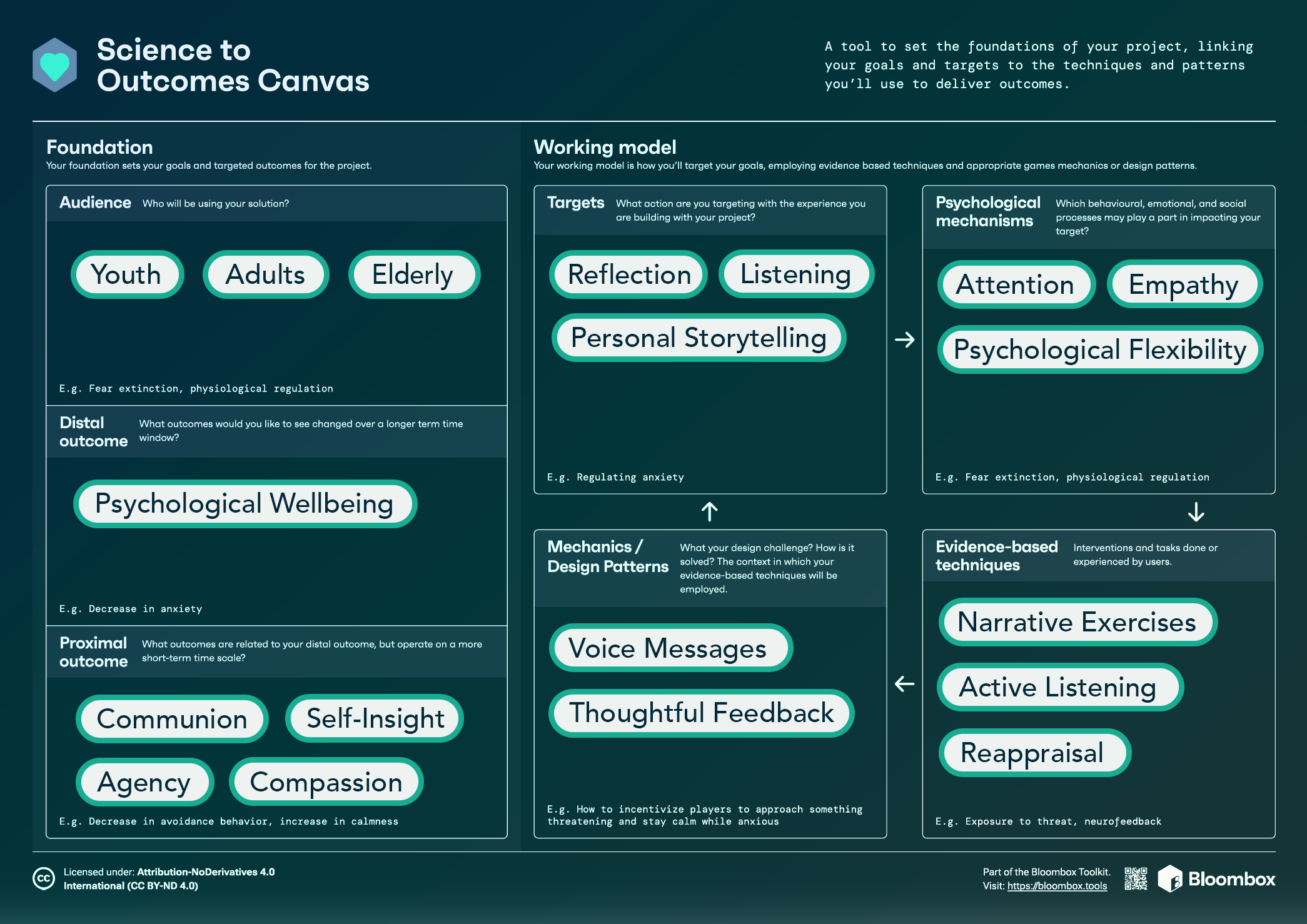
At the GEMH Lab we work according to the Bloombox, a toolkit that we have built up over years of researching and designing tech-for-wellbeing. The Bloombox Canvas shown here forms the foundation in all of our work, and the Wisperverse is no different.
By specifying our desired audience for the Wisperverse, as well as the desired long- and short-term outcomes, we set the stage for designing an experience with concrete goals for concrete people. Our Wisps are designed to invoke the psychological processes that have proven to affect the outcome goals. We take evidence-based techniques and transform those into design patterns that are engaging and effective.
 Wisperverse